

 Share:

Zigong, Sichuan province, has unveiled its development blueprint for the 15th Five-Year Plan period (2026-2030), setting out nine major goals and 24 key indicators as the city seeks to accelerate industrial transformation, strengthen emerging industries and build itself into an international tourism destination.
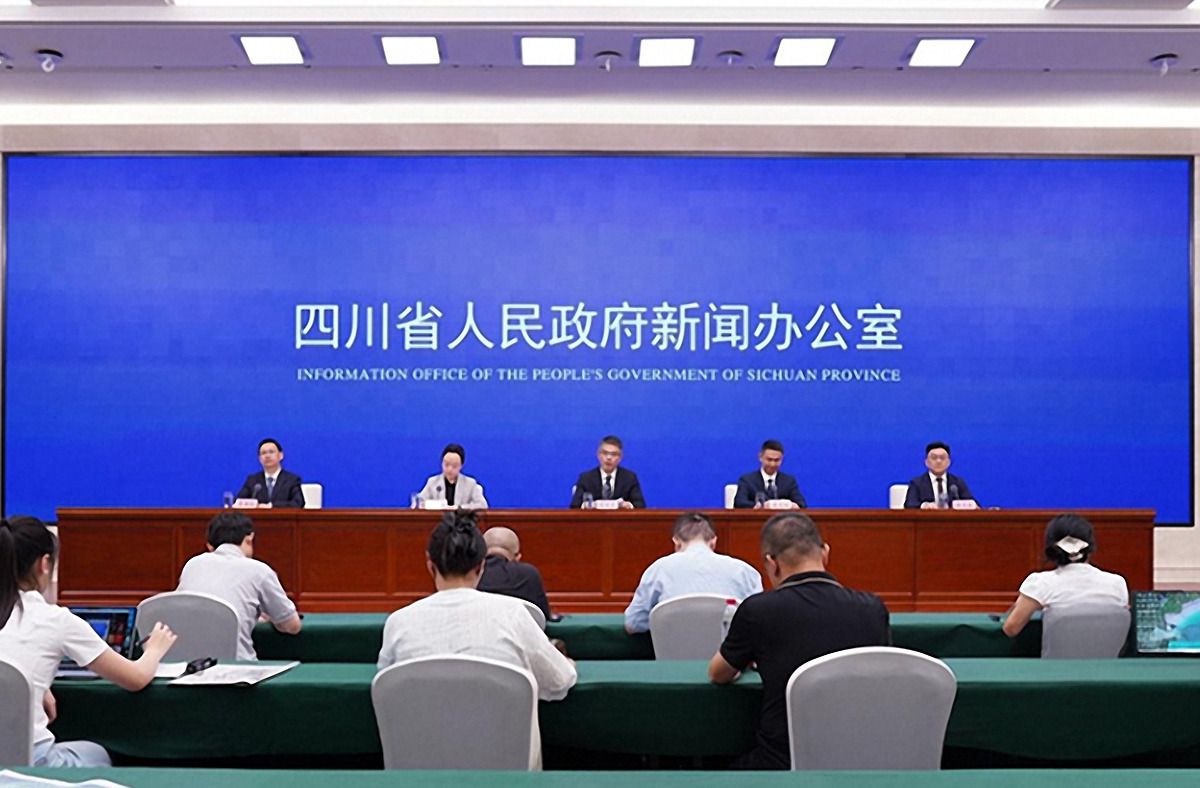
The plan was presented on Aug. 26 at a press conference in Zigong as part of the "Sichuan's New Momentum: Embarking on the 15th Five-Year Plan" series. Xiao Bingdong, a member of the Standing Committee of the Communist Party of China Zigong Municipal Committee and executive vice-mayor of Zigong, outlined the city's development priorities for the next five years.
During the 14th Five-Year Plan period (2021-2025), Zigong's economic and social development reached a new stage. The city's GDP surpassed 200 billion yuan ($27.8 billion), while per capita GDP rose from 57,000 yuan to 83,000 yuan. Its economic growth rate ranked among the top tier of cities in Sichuan.
More than 70% of the city's enterprises above designated size completed smart and digital transformation. The four leading industries of energy conservation and environmental protection equipment, new energy, new materials, and drones and general aviation accounted for 60% of the total industrial output value of enterprises above designated size.
Meanwhile, average life expectancy in Zigong increased from 77.6 to 79.1 years, while the urban-rural income ratio narrowed from 2.29 to 2.13.
During the 15th Five-Year Plan period, Zigong aims to achieve "nine new" goals, including a new leap in economic strength and new breakthroughs in industrial transformation and upgrading. It will implement four major initiatives —furthering its position within regional economic circles, strengthening the city through industry, revitalizing the city through culture and tourism, and promoting urban-rural integration — and launch 10 major projects, including a manufacturing-industry doubling initiative.
In the industrial sector, Zigong will strengthen its four leading industries — energy conservation and environmental protection equipment, new energy, new materials, and drones and general aviation — while developing three emerging areas with potential competitive advantages: artificial intelligence, electronic information and health and wellness.
The city has attracted a number of key companies in the new-energy sector and is developing a complete battery industry chain.
Its low-altitude economy has attracted 13 complete-aircraft manufacturers and more than 60 supporting enterprises and research institutions, making Zigong a major hub for the low-altitude economy industrial chain in Sichuan. The city has also been included in a national advanced aerospace manufacturing cluster.
During the 15th Five-Year Plan period, Zigong will focus on low-altitude manufacturing, supported by application scenarios and related services. It aims to raise the total output value of the entire low-altitude economy industrial chain to 30 billion yuan, with locally sourced components accounting for more than 60%.
Zigong has also attracted more than 60 artificial intelligence companies and established one of Sichuan's first pilot zones for AI innovation and development.
The city has prepared 1,896 projects for the 15th Five-Year Plan period, with a combined planned investment of 1.47 trillion yuan.
In culture, tourism, commerce and sports, Zigong will leverage its world-class cultural brands associated with salt, dinosaurs and lanterns. This will create a dual-engine development model driven by the cultural heritage and its ambition to become a city of sporting events.
During the 15th Five-Year Plan period, the city plans to invest 6.5 billion yuan in upgrading sports infrastructure and host more than 10 high-level international and national sporting events each year on average. It aims to generate more than 10 billion yuan in consumption driven by sporting events and accelerate the development of Zigong into an international tourism city.
Zigong will also strengthen ecological and environmental protection. It aims to ensure that 100% of monitored surface-water sections meet national and provincial water-quality standards and that 100% of monitored water bodies meet good-quality standards.
By 2030, new-energy vehicles are expected to account for more than 95% of the city's urban public bus fleet. Zigong also plans to increase its forest coverage area to 110,000 hectares and achieve annual forest carbon sequestration of 240,000 metric tons of carbon dioxide equivalent, further improving the city's ecological environment.


 京公网安备 11010802027341号
123bd748-03fa-42cf-860e-9004535b2ecb.jpg)